
The Future of Environmentally Friendly Logistics
Zero-Emission Couriers: The Future of Sustainable Logistics
Imagine you are driving with music on and traffic flowing normally. A large 18 wheeler pulls in front of you and releases thick exhaust. The smoke fills the road and blocks your view within seconds. This scenario sounds extreme, yet many logistics fleets still operate vehicles that produce heavy pollution. For drivers, pedestrians, and nearby residents, this level of exhaust remains a real and ongoing problem.
Logistics companies are responsible for 23% of worldwide greenhouse gas emissions (GHG). However, there is hope; continue reading to see why.
Electric vehicles are the future of logistics
The logistics industry is an important part of the global economy. In 2020, the global logistics business is expected to be valued £7.3 trillion.
The business is expected to reach £10.2 trillion by 2027. Its contributions to global trade and e-commerce transformed transportation. This has improved efficiency and production across the whole supply chain.
Many people find courier services convenient and reliable. Large multinational firms, small and medium-sized businesses, and individuals all benefit from them and the supply chain management they provide. The logistics industry gives businesses and consumers access to a reliable infrastructure for delivering goods and services. It is dependable and seamless.
The logistics business has become a significant source of air pollution. It accounts for 7% of worldwide CO2 emissions. This is an issue that must be addressed.
Logistics operations generate noise pollution. This annoyance may have a negative impact on the health of nearby residents.
As a result, customers are increasingly opting to support businesses that value environmental sustainability in their operations.
The industry is currently facing a huge challenge: reducing carbon emissions and noise pollution to provide green logistics. Fortunately, this is where electric vehicles come in. One of the most significant recent technological developments is the invention of electric automobiles.
Electric vehicles operate by electric motors rather than gas-powered internal combustion engines, which are used in many vehicles.
They can be powered by a battery or an external power source like a collector system, this reduces their carbon footprint making them more eco-friendly
Because of this, electric automobiles are the best choice for businesses that want to cut down on their carbon emissions and implement more sustainable practices.
Electric vehicles provide a simple, serene, safe, and quiet journey without the hassle of gear and control settings. They run at 90% efficiency, far above the 40% produced by combustion engines.
This increased efficiency results in more effective use of battery energy. Even more fascinating is how automotive engines may instantly convert renewable energy into generators, recovering kinetic energy quickly and effectively for reuse, while also conserving the environment.
Governments are actively advocating legislation that encourages greener logistics practices such as the replacement of internal combustion engines with electric vehicles. This often comes in the form of tax breaks for businesses and individuals who make the transition.
As expected, businesses have begun to use electric vehicles for distribution, and logistics and electric mobility are becoming increasingly integrated. Electric vehicles don’t require frequent engine oil changes. Oil will no longer be the primary energy source in the logistics business.
Electric automobiles have a lower environmental impact. They are becoming more appealing to the logistics sector because of their lower operational costs compared to standard ICE trucks.
As a result, businesses are increasingly relying on electric vehicles for cargo and package transportation.
Electric automobiles have a simpler design, making it easy to include new technologies. These tools enable tracking and improve fleet operations, resulting in lower costs for last-minute deliveries.
EVs also improve routing efficiency for freight businesses and open up new options for brand image.
The growth of e-commerce has also increased urban automobile traffic due to reverse logistics. Trucks powered by combustion engines are often used to transport goods and return products to warehouses. Businesses that switch to electric trucks could save money by optimising fuel consumption while also ensuring more sustainable logistics operations.
The most common argument against electric vehicles is that they are expensive to purchase and require regular charging. However technological trends and innovations leading to improvements to battery life, mileage range, increased numbers of charging station locations are making implementing green logistics simpler by the day.
It is true that some automobiles require less maintenance. They’ve also improved energy efficiency and reduced fuel costs. As a result, businesses can save significant savings. Furthermore, to address the issue of consistent charging, many logistics companies may need to invest in their own charging facilities. These can often be offset though the tax breaks if they reduce emissions and provide efficiencies that create other cost savings.
Ultra-Low Emission Zone
The UK government is making significant progress towards reducing the country’s contribution to climate change while also improving public health.
The Ultra-Low Emission Zone (ULEZ) is a London-based initiative that seeks to minimise air pollution. It is just one of several processes taken to reach this goal.
The UK government discovered that Londoners are suffering health-wise owing to poor air quality, which is primarily caused by automobile emissions. To remedy this, they introduced the ULEZ (£12.50) daily charge.
To travel in the ultra-low emission zone, your vehicle must meet ULEZ criteria. Drivers of non-compliant vehicles must pay a daily fee to drive in the zone.
This effort aims to promote cleaner air. This is in addition to the Congestion Charge, which encourages the use of vehicles with low or zero emissions.
The ULEZ will expand into all London boroughs beginning August 29, 2023.
This expansion into large cities will have a significant impact on London’s logistics sector. Companies must transition to electric vehicles or face high costs that could force them out of business.
Companies that adapt to the new reality will experience long-term success. Those that fail to adapt, on the other hand, will face significant challenges.
From 1st of June 2023 Glasgow has introduced its own LEZ system, details of which can be found at GlasgowLEZ
This shows that sustainable logistics practices will become increasing important for local and national couriers
Epax Couriers’ Evolution
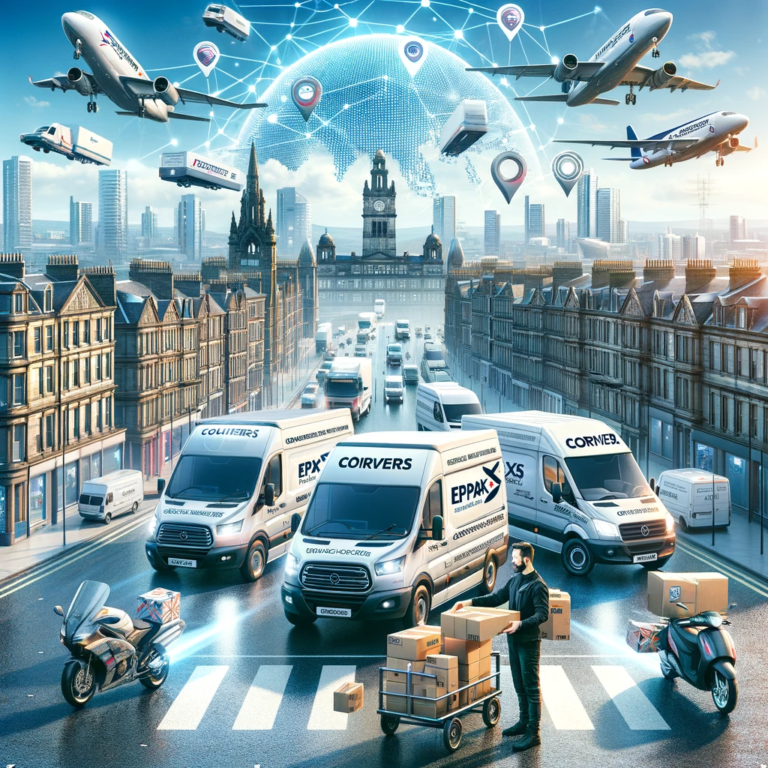
Epaxs Couriers, which specialises in time-bound courier services, is dedicated to providing services that keep you happy and satisfied. We specialise in medical delivery, same-day delivery, next-day delivery, and worldwide shipment.
Epaxs Couriers recognises its relevance in Glasgow’s logistics industry. They are taking steps to cut carbon emissions, such as developing zero-emission zones.
The business is shifting to electric automobiles by replacing end-of-life vehicles with environmentally friendly alternatives. This is to eliminate its reliance on non-renewable vehicles.
Epaxs Couriers understands the advantages of using electric cars. These include improved air quality, reduced fuel costs, and dependable and quiet operation.
We want to give superior delivery services. To do this, we believe electric vehicles are a wise and sustainable choice for the future. By including EVs into our motorcade, we are making a concerted effort to support a sustainable future for transport and courier services.
We are also working on additional sustainable, dependable, and environmentally beneficial alternatives. In this way, we can continue to give the exceptional service for which we are known.